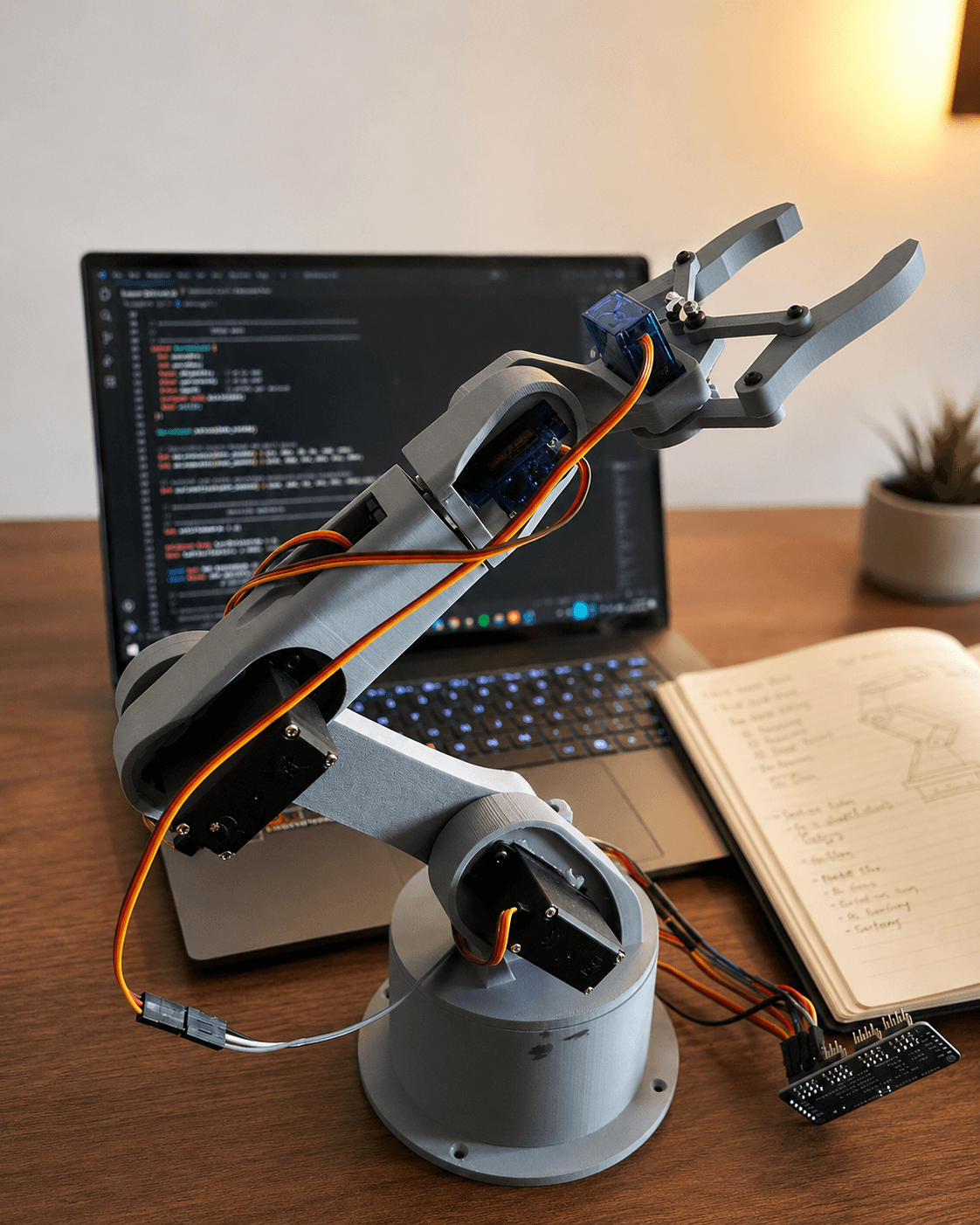
IEEE Bionic Arm
A 6-DOF bionic arm developed through rapid mechanical, electrical, and embedded iteration. As mechatronics team lead, I guided design and fabrication while programming responsive ESP32 control firmware.
Mechatronics Engineering Team Lead
January 2025
Multidisciplinary student engineering team
30% Faster
Prototype Iteration Time
Mechatronics Integration
Core Domain
Multi-DOF Bionic Arm
System Type
Overview
A 6-DOF bionic arm developed through rapid mechanical, electrical, and embedded iteration. As mechatronics team lead, I guided design, fabrication, and revisions while programming the ESP32 control system.
Problem
The team needed a responsive, maintainable arm that could be prototyped quickly and integrated across mechanical, electrical, and embedded disciplines.
Objectives
- Reduce the time required to test mechanical revisions
- Schedule responsive ESP32 control tasks deterministically
- Document wiring and maintenance clearly
- Improve gripper torque transfer while reducing mass
System Architecture
An ESP32 coordinates timer-scheduled control tasks and servo actuation. The embedded system connects to a mechanically iterated 6-DOF arm and a lightweight geared gripper, supported by documented electrical wiring.

Hardware
- ESP32
- servos and actuation hardware
- 3D-printed structural and gripper components
Software
- C++
- deterministic timer-based scheduling
Algorithms / Processing
- scheduled real-time control tasks
- servo actuation and gripper control
Key Decisions and Tradeoffs
- Used rapid 3D-printed prototypes to validate concepts before final fabrication
- Redesigned the gripper around servos, fasteners, and printed gears to improve torque transfer while reducing mass
- Created AutoCAD Electrical drawings to make wiring and maintenance clearer
Biggest Challenge
The central challenge was coordinating rapid mechanical revisions with responsive embedded control. Short prototype loops and clearer electrical documentation helped the team validate changes earlier and integrate them more reliably.
Validation and Testing
- rapid testing with 3D-printed prototypes
- servo and gripper checks
- embedded responsiveness testing
- mechanical-electrical integration checks
Impact
The team reduced prototype iteration time by 30%, while timer-based ESP32 scheduling improved system responsiveness by 15%.
Next Improvements
- Add more robust input-processing and motion-smoothing detail
- Improve validation pipelines
- Deepen actuation integration