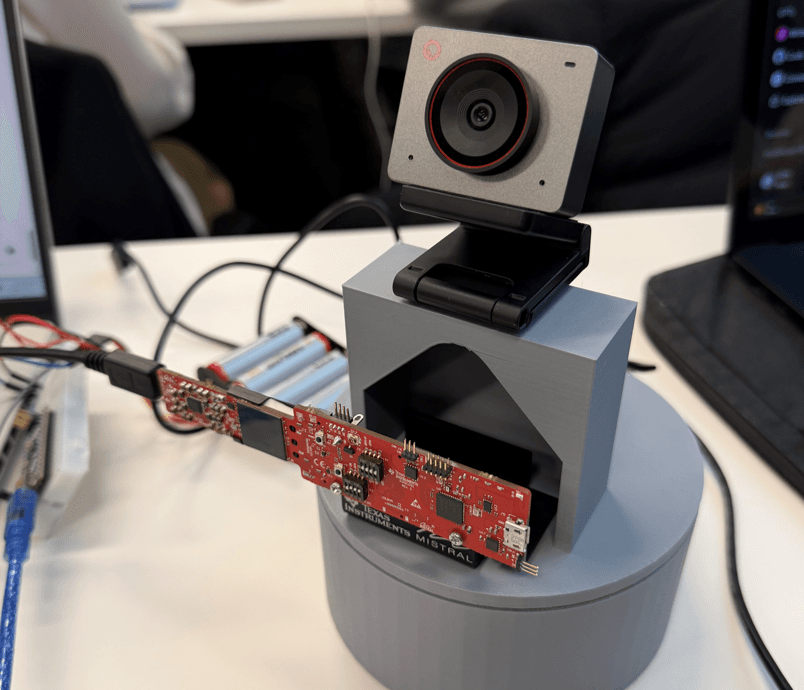
Waiting Room Monitoring System
A healthcare monitoring prototype exploring how passive observation could support earlier awareness of patient-condition changes in waiting-room environments.
System Integration and Prototype Development
April 2026
Multidisciplinary hackathon team
Functional Prototype
Project Stage
Healthcare Environments
Primary Context
High-Level Summary
Public Disclosure
Overview
This project explored a system-level approach to passive monitoring in healthcare waiting rooms. The goal was to investigate how a shared-environment prototype could help staff maintain awareness of patient-condition changes without adding another wearable or manual check to the workflow.
Confidentiality note: To respect project confidentiality, hardware architecture, sensing methods, algorithms, performance data, and implementation details are intentionally not disclosed. This page is limited to the project context, my responsibilities, and the high-level engineering process.
Problem
Waiting rooms create a difficult monitoring gap: patients may remain unobserved for extended periods while clinical teams manage competing priorities. The project examined how a passive monitoring concept could support situational awareness while accounting for privacy, workflow, and deployment constraints.
My contribution
I contributed to system integration and prototype development within a multidisciplinary team. My work centered on translating the healthcare use case into a coherent system concept, coordinating interfaces between project areas, resolving integration issues, and helping shape a credible demonstration under a compressed timeline.
Engineering approach
- Defined the intended user and monitoring workflow before narrowing the system concept
- Treated privacy and clinical context as design constraints rather than afterthoughts
- Prioritized a clear end-to-end demonstration over disconnected technical features
- Iterated quickly across integration, testing, and presentation needs
Outcome
The team produced a functional prototype and demonstrated the intended monitoring workflow. The project strengthened my experience working across disciplines, integrating an ambiguous system under time pressure, and communicating technical tradeoffs to a broader audience.
Next steps
Further development would require formal privacy, safety, clinical-workflow, and validation reviews before the concept could be considered for real-world use.